At Corruseal, performance testing of our customers’ packaging is never left to chance. Every corrugated solution is developed with a strong focus on structural integrity, real-world performance and fitness for purpose — because packaging that fails in transit, warehousing or handling ultimately costs a business far more than the box itself.
From FMCG supply chains and retail distribution to industrial applications and e-commerce fulfilment, we make it our job to understand how a package will perform under pressure. That means understanding its journey to market, and then combining technical knowledge, advanced testing processes and practical manufacturing experience to engineer packaging solutions that balance protection, efficiency and cost-effectiveness.
In corrugated packaging, “strength” is not a single measure. It is the combination of multiple performance characteristics working together to ensure a box can withstand the real-world conditions it will encounter throughout the supply chain.
Corrugated packaging operates in demanding environments. Boxes may be stacked in warehouses for extended periods, exposed to varying humidity levels, handled repeatedly during distribution, transported over long distances, or subjected to impact and movement during loading and unloading.
In South Africa, packaging often faces additional challenges linked to long road transport routes, the state of road infrastructure, multiple handling points and varying climate conditions. Harsh braking, vibration, cornering and unstable road surfaces can all create significant lateral forces that place additional stress on packaging during transport.
As a result, packaging design and performance cannot rely on assumptions. They must be measured scientifically.
This is where packaging strength testing becomes essential. Different tests measure different types of stress and structural behaviour, helping packaging designers determine whether a box is suitable for its intended application.
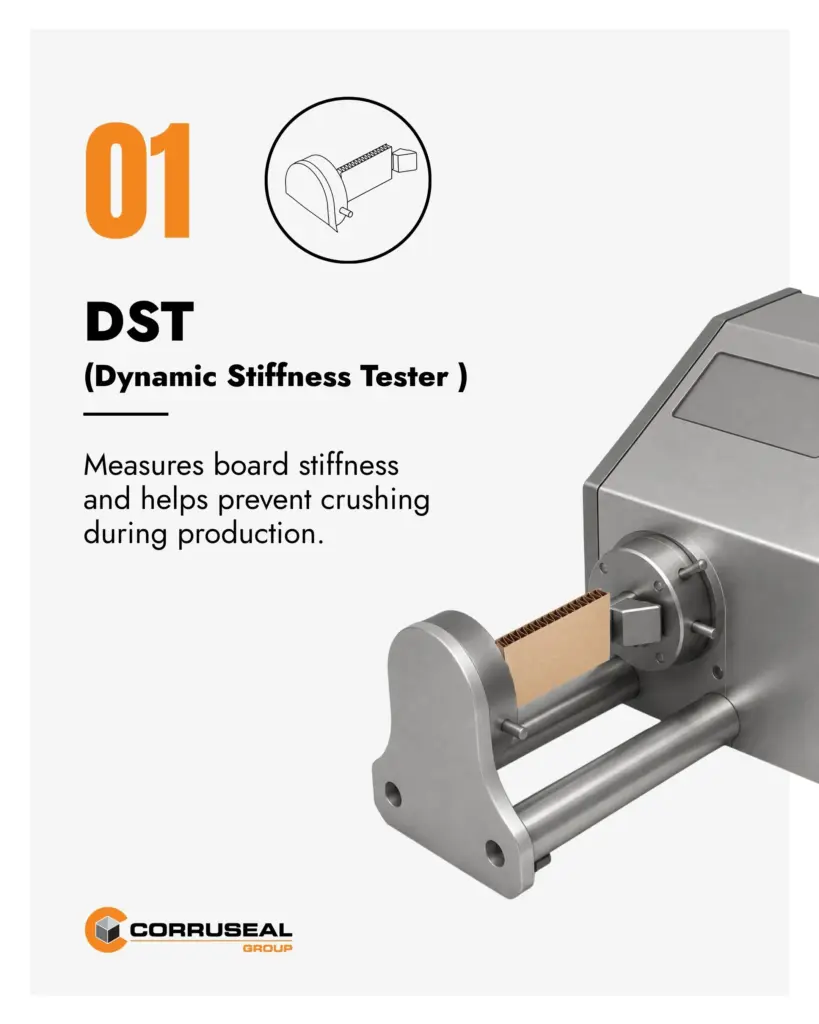
The Dynamic Stiffness Tester (DST) is an advanced quality control instrument used to measure the Machine Direction Torsional Stiffness (MDTS) of corrugated board. Unlike more traditional destructive tests such as ECT or BCT, which often require samples to be removed and tested in a laboratory environment, DST is a fast, non-destructive test commonly performed directly alongside the corrugator or printing process.
DST measures the board’s resistance to torsional forces — in other words, how well the corrugated structure can withstand twisting, flexing and lateral stresses without losing integrity. This is particularly important in real-world transport environments where packaging is subjected to vibration, harsh braking, cornering, shifting pallet loads and uneven road surfaces.
The test plays a critical role in preventing “crushing” during production and helps ensure the corrugated structure maintains its strength throughout converting, handling and distribution.
DST testing helps assess:
For high-volume production runs, DST provides practical quality control without interrupting production flow.
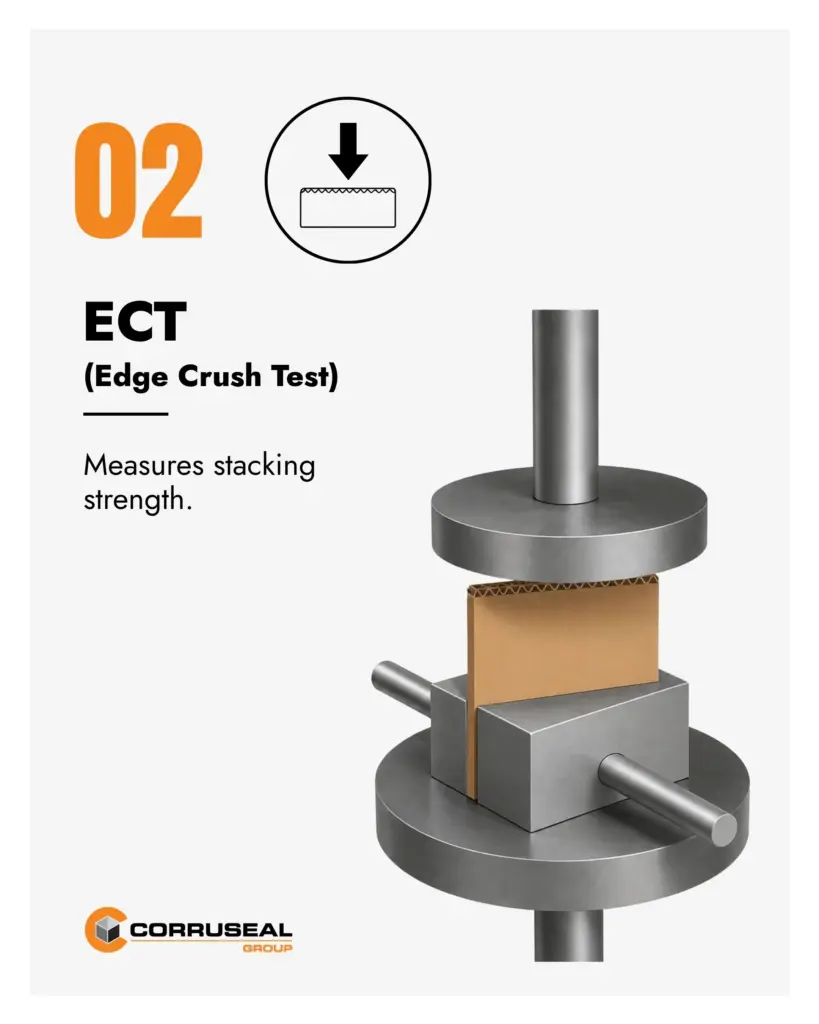
The Edge Crush Test, commonly known as ECT, is one of the most widely used corrugated packaging tests globally. It measures the compressive strength of corrugated board by determining how much force the edge of the board can withstand before crushing. In practical terms, ECT helps predict how well a corrugated box will perform when stacked vertically in warehouses, transport vehicles or retail environments. This is particularly important because stacking failure can result in:
Higher ECT values generally indicate stronger stacking performance, but the required strength depends on several factors, including box dimensions, product weight, stacking height and environmental conditions. For businesses managing warehousing and logistics at scale, optimising ECT performance is essential for both product protection and efficient palletisation.
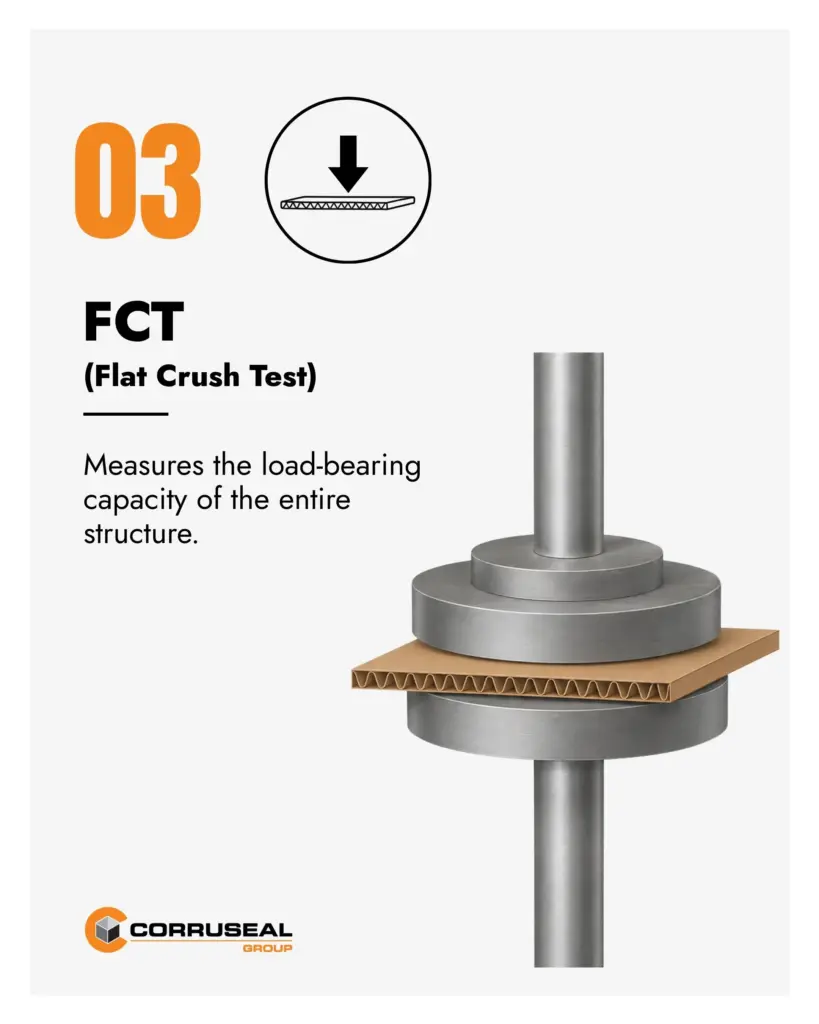
While ECT focuses on edge compression, the Flat Crush Test (FCT) evaluates the resistance of the corrugated fluting structure to crushing forces applied to the flat surface of the board. The fluting inside corrugated board plays a critical role in maintaining rigidity and cushioning performance. If the flutes collapse too easily, overall box strength and protective performance are compromised. FCT testing helps assess:
This test is particularly relevant in packaging applications where boxes may experience surface pressure during packing, transport or storage.
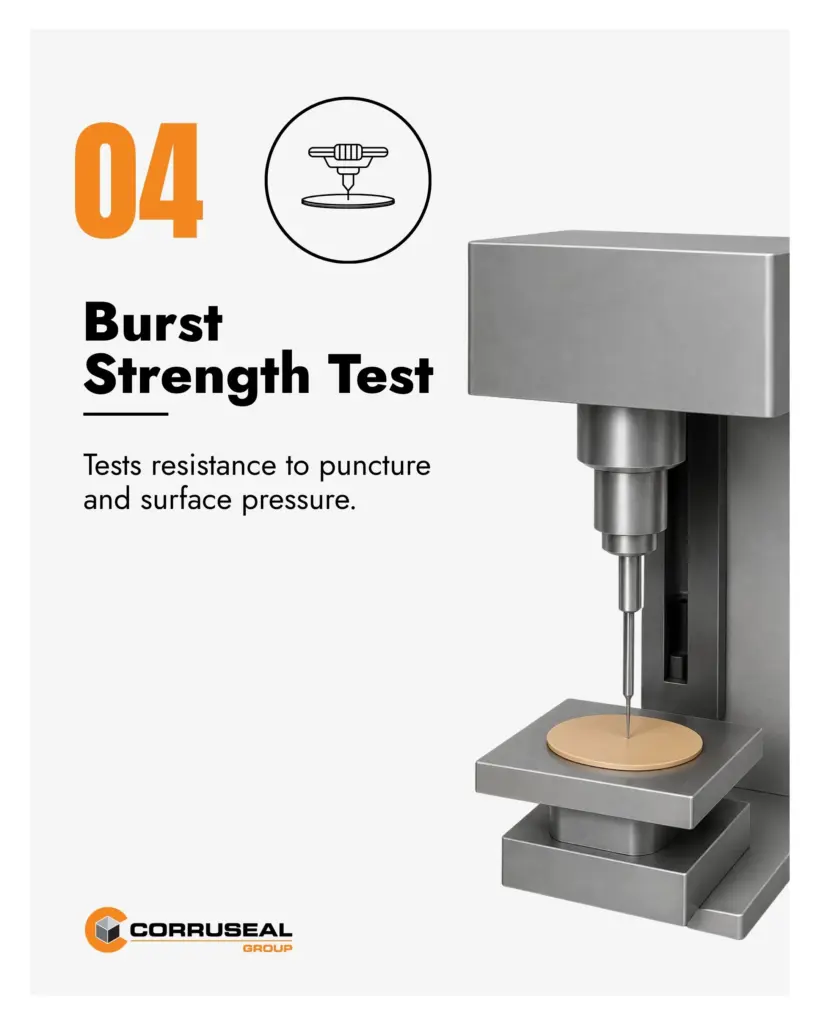
Burst strength testing measures the amount of pressure required to rupture the surface of corrugated board. In simple terms, it evaluates resistance to punctures, tears and external surface pressure. This test remains especially important for packaging applications exposed to rough handling, sharp-edged products or demanding transport environments. Burst strength performance can influence how packaging withstands:
No single packaging test can fully predict real-world performance. A corrugated box may achieve excellent ECT results but perform poorly under impact conditions. Another design may resist punctures effectively while lacking sufficient stacking strength for warehousing applications. That is why Corruseal evaluates multiple performance factors together when designing corrugated solutions.
The correct packaging specification depends on several variables, including:
By combining test data, packaging specialists can engineer solutions that are fit for purpose — strong enough to protect products without over-engineering packaging unnecessarily. Modern corrugated packaging is no longer simply about using “stronger board”. It is about designing smarter packaging systems based on measurable performance requirements. In many cases, accurate performance testing can even help reduce material usage by ensuring packaging is engineered precisely for its intended application rather than relying on excessive safety margins.
Speak to a Corruseal consultant about corrugated packaging solutions engineered for real-world performance.